Regimental Tartans & Squadron Kilts
The 7th U.S. Cavalry Tartan dates back to 1870 and was officially registered on New Years' day 1900.
Extract from the Saturday, 5 March 1949 issue of The People's Journal: "An entry from the nineteenth century shows a scrap of largely blue and red tartan
with the thread count falling in sevens, entitled 'The 7th Cavalry Tartan'. No British military formation has such a name, although there was an American 7th Cavalry, which
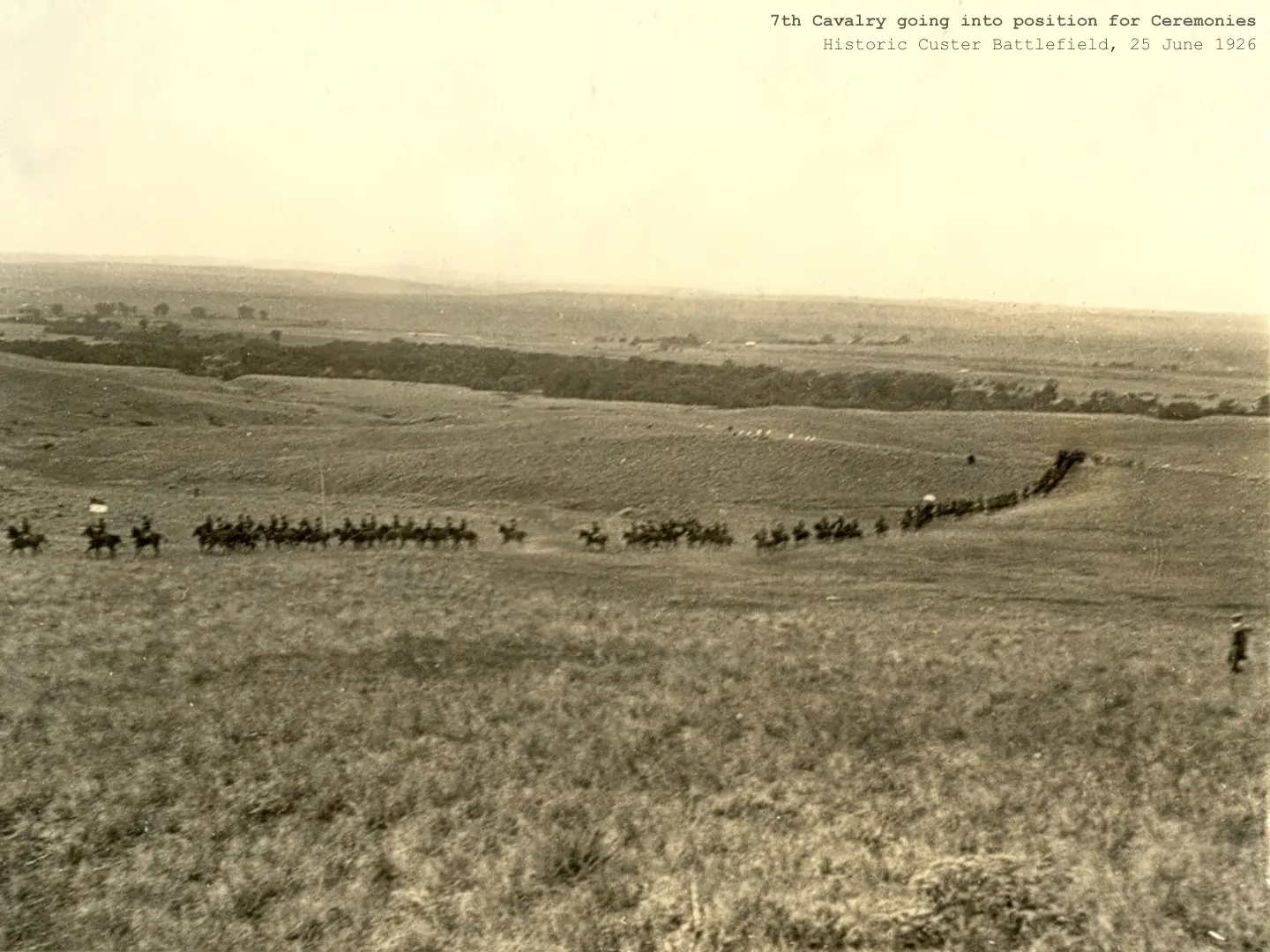
achieved fame under General Custer at the Battle of the Little Big Horn, when it was massacred by the Sioux Indians. Apparently, General Custer had a liking for military bands and
formed ad hoc brass and bagpipe bands. It is probable that the 7th Cavalry wrote to Scotland to commission a tartan for their pipers and drummers, since the regiment contained
many Americans of Scottish descent."
Note: the threadcount now contains none that are divisible by 7! The 'inherited' threadcount for this tartan was DB/46 W8 LG6 Y4 W4
Y4 LG6 W4 R16 W8 DB10 Lav6 LG4 Lav6 DB10 W8 R/8. In May 2006, the woven sample from the Paton Collection was checked and the threadcount entered here. Warp and weft were different
which produced a rectangular block of dark blue.
The Scottish Register of Tartans supplied details of this set to the 7th Cavalry in 1992, along with archival photographs and other details, so that the newly re-formed Pipers could have new uniforms made.
Tartan swatch provided by John Potts 2-7 KWV
Color Symbolism
The Tartan has 6 colors: red, dark green, white, gold, dark blue, and light blue.
- Red for action
- Dark Green for aspiration
- White for honor
- Gold of the U.S. Cavalry
- Dark Blue of the U.S. Cavalry
- Light Blue to signify the present-day Infantry role in the U.S. Cavalry
Tartan History
- 1954–1957
-
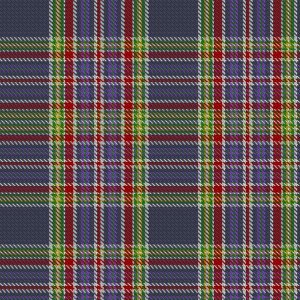
The 7th U.S. Cavalry tartan used officially from 1954–1957, 1968–1972, and 1992–1996 The 7th Cavalry Regiment Pipe & Drum Band is organized by SSG. Robert J. Scroggie in late 1954 at Camp Haugen, Japan.
On November 1st 1957, the Regiment was reorganized and redesignated. Company A was redesignated as 1st Battle Group, Company B was redesignated as 2nd Reconnaissance Squadron, and Company C was redesignated as 3rd Reconnaissance Squadron, leading to three GarryOwen Pipe & Drum bands.
- 1959–1962
-

The 2nd Squadron kilt
1959–1963The 2nd Reconnaissance Squadron is stationed at Warner Kaserne, Germany.
Under the Command of LTC Roger Rawley (1959–60), the band was reactivated under the leadership of CPT John Lindgren. It was decided that the Band would wear Irish Uniforms.
A Note About the Kilts
The uniforms are replicas of The Royal Inniskilling Fusiliers. The Kilts were saffron material, and was the regular army issue material for the Irish kilt. The color of the Kilts were plain burnt dull orange. These changes were made to reflect that former members of the Royal Irish Regiment had emigrated to the United States and enlisted as troopers of the 7th U.S. Cavalry. The pipes were Brian Boru (named after a ancient Irish King).
- 1963–1968
-
The 3rd Squadron kilt
1963–1968The 3rd Reconnaissance Squadron is stationed at Ledward Barracks in Schweinfurt, Germany
- 1968–1971
-

The 3rd Squadron tartan
1968–1971The 3rd Squadron at Ledward Barracks in Schweinfurt, Germany. * Here, the Kilt was retired and the 7th Cavalry Regimental Tartan was substituted with the Anderson Tartan (due to the cost of the original Regimental Tartan).
- 1992–1996
-
The 1st Squadron
& 2nd Battalion tartan
1992–1996The 1st Squadron & 2nd Battalion at Fort Hood, Texas (1CD Pipers). * The "original" Regimental Tartan was provided by the Korean War Veterans 7th Cavalry Association for the Divisional Bands.
- 1996–1998
-
The 3rd Squadron
tartan used 1996–1998The 3d Squadron at Fort Stewart, Georgia (3ID Pipers). * The "original" Regimental Tartan was provided by the Korean War Veterans 7th Cavalry Association for the Divisional Bands.
Timeline
- 1954
- The 7th Cavalry Regimental Pipe & Drum Band is organized in late 1954 at Camp Haugen, Japan by SFC Robert J. Scroggie, OIC 2LT James Davidson.
- 1957
- On November 1st 1957, the Regiment was reorganized and redesignated. Company "A" redesignated as 1st Battle Group, 7th Cavalry. Company "B" redesignated as 2nd Reconnaissance Squadron, 7th Cavalry. Company "C" redesignated as 3rd Reconnaissance Squadron, 7th Cavalry.
- 1958
- On April 25th 1958, the 2nd Reconnaissance Squadron was moved to Warner Kaserne in Bamberg, Germany.
- 1959
- 2nd Reconnaissance Squadron formed a Pipe ∧ Drum Band under the guidance of LTC Roger Rawley and Capt John L Lindgren. Band members were sent to a British regiment, the 1st Battalion Royal Inniskilling Fusiliers at Wuppertal where they were given preliminary training by Irish pipers and drummers from that regiment.
- 1959–1963
- 2nd Reconnaissance Squadron Garryowen Pipe & Drum Band at Warner Kaserne in Bamberg, Germany.
- 1963
- 2nd Reconnaissance Squadron is redesignated as 3rd Reconnaissance Squadron at Ledward Barracks in Schweinfurt, Germany.
- 1965
- 3rd Reconnaissance Squadron is redesignated as 3rd Squadron, 7th Cavalry
- 1963–1971
- 3rd Squadron Garryowen Pipe & Drum Band at Ledward Barracks in Schweinfurt, Germany (disbanded November 1971).
- 1992–1998
- 1st Squadron & 2nd Battalion at Fort Hood, Texas (1CD Pipers).
- 1996–1998
- 3rd Squadron at Fort Stewart, Georgia (3ID Pipers).
Today, units of the 7th Cavalry still use bagpipers, which are Divisional Band Members. We who knew the Band, saw them play and march, thank [them] for the memories. GarryOwen!
- Savage, James W
SGT, D-Troop 3-7 (1968-1969)
Webmaster, 7th Cavalry Association  'Fox'
'Fox'
Web Developer
Kitsunami Studios- Wikimedia Commons
for the images shown in the background scroll